Monday, January 3, 2011

Breaking Down & Rebuilding "Reels"

During the winter months, our mechanic is busy in the shop making sure that the equipment is ready to go for the season of 2011. The first job to be completed is a breakdown and rebuild of each cutting unit reel for the greens, tees, and fairway mowers. This is a very detailed procedure and takes plenty of time and experience to make sure all parts involved are prepared for the everyday use they will receive when the season begins.

All Rollers that are attached to the cutting unit are taken off, bearings are replaced, and regreased.

The counter weights are taken off as well, and given a fresh coat of paint. New bed knives are installed and given a new cutting edge by a grinder. The exterior of the bed knives and shields are given a fresh coat of paint also.
The cutting reel is also put on a grinder so that each blade is given a sharp edge so that all grass will be cut and not torn. The rollers, shields, counter weights, and bed knives are reassembled to produce a completed cutting unit that is ready for the 2011 season.

The process above must be completed 5 times to make up a "set" of reels for 1 fairway mower. The reels and bed knives are sharpened when needed throughout the season to maintain an excellent cut. However, the bearings in the rollers and the reels are only replaced during the winter.


Thursday, December 16, 2010

Hexagon Plugging To Thin Spots on #7 green

During the months of November and December, hexagon plugs were placed in the thin spots on #7 green to promote healing into the spring. These plugs were taken from the back edges of the greens and transplanted into areas where turf was needed. This will aid in speeding up the progress of "filling in" the thin areas on the greens surface.

Hex plugs were also used on greens #6, #9, and #17.

This is what the areas will look like after growing conditons allow the turf spread. We also follow up with 2 to 3 topdressing applications to smooth and level any indescrepancies on the surface of the green.

Wednesday, December 15, 2010

Bermuda Grass Approach on #9

The Summer of 2010 was one for the history books of weather. Extreme humidity and extreme temperatures that occured from the months of late June into mid September was just too much for turf in some areas of the course. A particular area of the course that really stood out where this happened, is the fairway/approach on hole #9. This area has a history of staying wet longer than other areas, so the old drainage was removed, and new drain pipes and pattern were installed.

This area also receives full sunlight for the majority of the day. The long hours of sunlight as well as the wet conditions that existed, made it impossible for the cool season turf that was there to survive in summer stress periods.

The approach area on this hole was determined as a microclimate within the golf course, therefore we decided to install the warm season bermudagrass, which will thrive in this area. This will correct the problem of playing conditions declining during the summer months.

Monday, December 13, 2010

Winter Maintenance For Irrigation System

Once again it is that time of year to make sure last years water is out of the irrigation system in preparation for the long cold months ahead. The actual pump station has been shut down and winterized since the middle of November. This operation is completed by a contractor mechanic who specializes in maintaining the pump station.
However, the irrigation lines on the golf course and the valves that control the water flow thru these lines are winterized by the maintenance staff. We do this by pressurizing the system with high pressured air supplied by a compressor. Below are a couple of pictures explaining this process.


This is the compressor that is rented for the day to perform the blowout of residual water in the irrigation lines. All valves are opened so that air can freely flow throughout the lines pressurizing the system with air instead of water, so that irrigation heads can be activated to release the water within the lines.
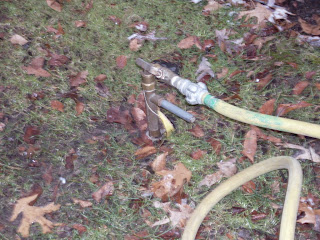

The compressor's air hose is connected into a hose adapting port that is used for the retrieval of water during the season, but used to pump air into the lines this time of year during the blowout operation. When the lines are fully pressurized with air, the irrigation heads are manually turned on one hole at a time until water stops appearing from each individual head on each particular hole. This operation usually takes 8 hours to perform, by starting with the practice area, and then going #1 thru #18 with the activation of irrigation heads.


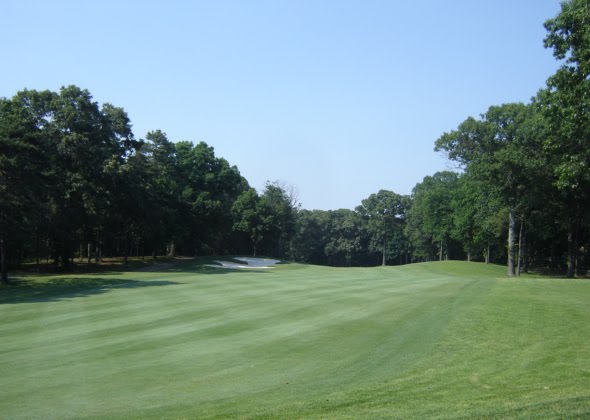
This is a picture i snapped this morning on December 13th, showing the scene at the clubhouse and practice green. This is just a reminder that winter is here, but hopefully this scene will not appear as many times as it did last year!
Friday, December 10, 2010

"Winter Work"


With Leave cleanup at a minimum now, and cold winter temperatures arriving early in December, our focus has turned to improving conditions for the 2011 season. Underbrushing of tree lines, limbing the lower branches on larger trees, and the removal of dead trees are on going. We have started with hole #11, because of where this operation concluded on #10 the previous winter. We will continue this for holes #12 thru #18 as mother nature and time permits. The pictures below show this work, as well as some detail cleanup we have completed with ornamental beds throughout the property.


The ornamental beds around the clubhouse area have been cleaned of leaves and debris, producing a clean appearance when arriving. The ornamental beds on the golf course are in the process of being completed as well.


All trees along the right side and behind #11 green have been limbed, producing a higher canopy so that air can move freely across the surface of the green.


We have started the underbrushing and limbing operations beginning with the right side of #11. Our goal is to improve the air movement for the turf in the fairway, as well as improve the overall aesthetics of the hole.

Thursday, May 13, 2010

New Cart Path Exit Regulations

Our goal is to provide an easy reference point for golfers to know to exit the fairway and improve safety by eliminating many ropes on the course. This system is more visual; however, we must rely on all golfers to follow these regulations to insure peak playability.

Ropes on the ground have been added to mark the exit point for golf carts on the fairway. Exit signs can be found on either side of the fairway too.
Please do not drive beyond, through, or around white stakes. Carts approaching the stakes should exit the fairway at that point.

Follow the rope and signs to the fairway exit point. Then drive around stake nearest the path.


Monday, May 3, 2010

Spring Improvements and Enhancements

The finished look here on hole #12 shows what the new sand does for the contrast of color between turf and sand. It definitely has changed the overall appearance of the green complex.
New bunker sand has been added to greenside bunkers on the back nine. Playability will be an issue at first, but the sand will compact with time and weather.

Three newly planted trees to the left of the blue/white tee on #16 will give the tee shot from the back tee more character and separation from surrounding holes.


Trees were planted to the left of 13 tee to develop a tree line that will separate holes #13 and #16 in the years to come. The trees that separate the holes now are continuing to age, become diseased, and die. When those trees are removed in the coming years, the newly planted trees will become the new tree line.